
01 — INFORMATION A film starts with information, not a prompt
This short film is both an introduction and a tribute to Dr. Mohammadreza Kia, an Iranian scientist. Before making any film, I need information. Here, the client was Dr. Kia's sister. The brief did not arrive as one neat document, so I had to find the useful details through a series of questions and answers.
I was first told that people in Lahijan had moved toward the ruins. Later, I learned that he had been in the village of Dastak, some distance from Lahijan. Because the geography was not completely clear, I used a symbolic view of Lahijan instead of presenting it as the exact place.
Based on the information the family shared with me, I learned that:
- Dr. Kia was a scientist and was killed together with his wife in a bombing.
- The family supplied photographs of him and of the couple.
- The last photograph available to me showed the two of them praying.
- That prayer photograph became the visual spark for the whole film.
02 — STORY DESIGN The most important decision was what the film was for
I sat down and asked myself two basic questions:
- Was I making a sad film for the family, a political statement, or an introduction to this scientist for a wider audience?
- What would give someone a reason to keep watching?
I chose the third objective. To create a reason to watch, I built a symbolic version of the final moments around the quietness of prayer, an aircraft in the sky and the feeling that something terrible is approaching. The film does not claim to reproduce the real event shot by shot; it creates an emotional path toward it.
A good AI shot is not yet a film. The story is what tells every shot why it exists.
There were smaller questions too: What if I connect these images? What story is hiding inside this reference? Should the final film be vertical or horizontal? The answers gradually shaped the sequence.
03 — PRODUCTION / BASE IMAGES Turning one family photo into a controllable cinematic world
I started with the photograph that triggered the story: the couple praying. I converted it into a warm cinematic 16:9 frame while preserving the room, prayer positions and modest clothing.
Prayer still — image prompt
Convert this reference photo into a cinematic 16:9 film still.

Keep the same scene, same room, same two people and their prayer positions (both in sujud/prostration on the Persian rugs, the woman in front covered by her light floral prayer chador, the man behind her). Correct the man's clothing: extend his olive-green shirt so it falls loosely over his waistband and fully covers his lower back and hips — modest, natural drape, no skin or waistband exposed.

Reframe as a wide 16:9 cinematic composition, low camera height near floor level, slightly wider field of view to include the rugs, potted plants and the glass door with warm daylight filtering through.

Photographic treatment: shot on 35mm cinema film with an anamorphic lens — subtle horizontal flares, oval bokeh, gentle edge falloff, shallow depth of field with focus on the two figures. Warm color tonality: amber and golden highlights, soft warm shadows, rich but restrained saturation. Visible fine 35mm film grain, natural halation, soft organic contrast. Dramatic, intimate, reverent mood; devotional stillness, quiet emotional weight.

Photorealistic, high detail in fabric texture, carpet patterns and skin, faces not visible, no text, no watermark.
Then: a location sheet
An image model needs a coherent idea of the whole room. Otherwise, changing the camera angle often makes it move the people or redesign the furniture instead of moving the camera. I learned that the hard way. I removed the characters from the base image, then asked for a six-view room sheet.
Interior multi-view reference sheet
Generate a single high-resolution multi-view reference sheet (contact sheet / turnaround layout) of the interior room shown in the attached image.

Layout: a clean grid of 6 panels with thin dark separators and small labels in the corner of each panel:
1. WIDE — REVERSE ANGLE (camera turned 180°, looking back from the French doors into the room's interior wall)
2. CORNER — LEFT (angle covering the armchair corner and the adjacent wall)
3. CORNER — RIGHT (angle covering the potted plant side and the perpendicular wall)
4. TOP-DOWN / FLOOR PLAN VIEW (overhead view showing rug placement, furniture footprint and door position)
5. EYE-LEVEL WIDE — DOORS (standing height view facing the glazed doors and window bay)
6. DETAIL / MID SHOT (rug texture, floor transition and baseboard detail)

Consistency rules across all panels:
- Preserve exact identity of the location: layered antique Persian rugs with faded blue-teal and gold medallion patterns and fringed edges, matching wooden mid-century armchair with worn leather cushion, tall interior plants in woven and ceramic pots, glazed white-painted French doors with lower panels, warm terracotta-toned tile flooring, muted plaster walls.
- Same lighting scenario throughout: low golden-hour sunlight streaming through the doors, long soft shadows, warm amber highlights, deep shadowed corners, gentle atmospheric haze and subtle lens flare where sun is in frame.
- Where geometry is not visible in the reference, invent it plausibly and coherently: continue the same wall finish, add period-appropriate furnishings while keeping the same era, palette and material language.
- Cinematic photographic look: full-frame 24–35mm perspective, shallow-to-medium depth of field, natural film grain, warm color grade, no text overlays other than the small panel labels, no people.

Output: one cohesive sheet image, evenly exposed panels, 16:9 overall frame.
And finally: character sheets
I also generated consistent reference sheets for both people. These gave the video model a clearer view of faces, proportions, clothing and side profiles. For privacy, I am sharing the prompts but not the sheets themselves.
Dr. Kia character sheet
Create a professional character reference sheet (model sheet) of the same man from the provided reference photos, keeping his facial identity, glasses, short beard/stubble, and hair swept up and back perfectly consistent across every frame.

Layout: one clean image divided into 5 clearly separated panels on a plain neutral light-gray studio background, even soft studio lighting, no shadows on background:

1. Frontal head-and-shoulders portrait, neutral expression, looking straight at camera
2. Head profile, exact 90-degree side view, neutral expression
3. Full-body standing shot, front view, arms relaxed at sides, full figure visible head to shoes
4. Full-body standing shot, exact 90-degree side profile, natural relaxed posture
5. Frontal head-and-shoulders portrait with a wide genuine smile showing teeth

Character: man in his early 30s, slightly overweight with a fuller face and build, thin dark-framed rectangular eyeglasses, short dark hair styled upward and backward, dark stubble beard and mustache with light gray flecks, wearing a plain light pale-green crew-neck t-shirt and long beige cotton trousers, simple casual shoes.

Style: photorealistic, sharp focus, consistent skin tone and body proportions in all panels, same camera height and identical lighting across frames, high resolution, character design sheet aesthetic.
Wife character sheet
Create a professional character reference sheet (model sheet) of a single female character, approximately 30 years old, based on the woman shown in the provided reference images. Preserve her exact facial identity, features, and proportions consistently across every view.

Character appearance: Iranian woman in her early 30s, fair skin, defined dark eyebrows, hazel-brown almond eyes, natural soft makeup, wearing a traditional white/light floral-patterned chador namaz (prayer chador) draped over her head and shoulders, framing her face fully.

Sheet layout: clean, evenly lit studio-style character sheet on a neutral light gray background, arranged in a grid with clear separation between panels:
- Full-body front view, standing, neutral pose
- Full-body 3/4 view
- Full-body side profile view
- Full-body back view
- Head-and-shoulders close-ups: front, 3/4, and profile
- A small row of facial expression studies (neutral, gentle smile, calm/serious)

Technical: photorealistic, high detail, consistent lighting and identical character scale across all views, soft diffused frontal lighting with no harsh shadows, sharp focus, accurate fabric folds and drape of the chador, 8K quality, no text, no watermark, no additional characters.
04 — VIDEO GENERATION / PRAYER Scene 01: making one room survive several camera angles
I passed the room sheet, character sheets and the main prayer still to Seedance 2.5, chose a 15-second duration and described the sequence shot by shot. The prompt locks the room, identities, prayer order, light direction and hard cuts so the model has fewer opportunities to improvise the wrong thing.
Seedance 2.5 — prayer sequence prompt
SEEDANCE PROMPT — 16:9 | Cinematic Fine-Film Stock | Realistic Anamorphic Lens

GLOBAL SPECS
Aspect ratio 16:9. Shot on cinematic fine-grain film emulation, anamorphic spherical-flare optics with realistic anamorphic distortion, subtle horizontal flares, oval bokeh, gentle edge falloff, natural film grain, warm golden-hour color science, deep shadow rolloff. Handheld-free, precision camera work. Consistent 24fps cinematic motion. Clean hard cuts between shots — NO AI morph, NO dissolve, NO warping transitions.

CHARACTERS & LOCATION (locked references)
[image_2]: the interior location for every shot, unchanged geometry, unchanged furniture placement, unchanged Persian rugs layout, unchanged low golden sunlight streaming through the balcony doors.
[image_1]: the exact staging, wardrobe and body language of the praying Shia Muslim couple.
[image_4]: the husband, identical facial identity, glasses, beard, hair.
[image_3]: the wife, identical facial identity, wearing her floral prayer chador.
The wife stands and prays strictly BEHIND the husband in every single shot. Same two people, same wardrobe, same room, same light direction throughout.

SHOT 1 — WIDE, BEHIND THE COUPLE
Wide framing from behind the standing couple, husband in front, wife one step behind him, both facing the sunlit balcony doors in Qiyam (standing prayer posture), hands at their sides in Shia prayer stance. Camera glides on a slow, silky cinematic slider move from left to right at eye level. As the camera travels, the low golden sun source passes directly behind the silhouettes — backlight blooms around their shoulders, anamorphic horizontal flare streaks across the frame, dust motes ignite in the beam, silhouettes rim-lit in amber. Composition breathes, contemplative pacing.

SHOT 2 — CLOSE-UP, 45° ON THE HUSBAND
Hard cut. Close-up of the husband at a 45-degree three-quarter angle, shallow anamorphic depth of field, background rug and warm window light softly melted into oval bokeh. He slowly raises both open palms upward for Qunut, hands cupped at chest-to-face height in authentic Shia posture, fingers relaxed and anatomically correct. His lips move in a barely audible whispered dhikr. Micro-expressions of sincerity, eyelids lowered, breath visible in his chest. Camera locked, no movement.

SHOT 3 — TOP-DOWN, PERFECT 90° OVERHEAD
Hard cut. Perfectly perpendicular overhead bird's-eye shot directly above both subjects on the Persian rugs. Camera completely static, no drift, no rotation. Both figures descend from standing into Sujood in synchronized, natural, physically accurate motion. Bodies anatomically correct, realistic joint articulation, knees folding first, hands placed flat and naturally on the rug shoulder-width apart, foreheads lowering fully to touch the prayer rug. No warped limbs, no broken joints, correct body orientation toward the same Qibla direction. Wife's frame remains clearly behind the husband's. Fabric of the chador and clothing folds with realistic weight and cloth simulation. Golden window light rakes across the rug patterns from frame edge.

SHOT 4 — STATIC CLOSE-UP, FRONTAL ON THE HUSBAND
Hard cut. Locked-off frontal close-up. The husband occupies the right two-thirds of the frame in sharp focus; the wife is visible in the left one-third, fully out of focus, soft creamy anamorphic bokeh. Both rise from Sujood into the seated two-knee Julus position — realistic weight shift, spine unfurling, hands sliding onto thighs, no teleporting or snapping motion. The husband's gaze rests downward with the specific stillness and humility of prayer, lips moving gently through the whispered Tashahhud. Beat of silence. Then, as the prayer concludes, a wave of calm settles into his face and he slowly lifts his eyes upward — serene, fulfilled, spiritually arrived. Hold on that expression.

AUDIO
No music. Precise, high-fidelity ambient sound design only: soft whispered Arabic dhikr and Tashahhud under the breath, the muffled rustle of cotton and chador fabric against wool rug, faint knee and fabric contact on the carpet, distant muted city and birdsong bleeding through the balcony glass, quiet room tone, subtle breathing.

NEGATIVE / CONSTRAINTS
No music. No morph transitions. No facial morphing or identity drift. No wardrobe change. No object teleportation. No lighting-direction change. No extra people. No wife in front of husband. No distorted hands or limbs. No text or watermark. No modern stylization or over-saturation.

MOOD
Dramatic, intimate, contemplative, spiritually rooted, emotionally restrained, respectful, quiet, deeply human, cinematic realism.
05 — THE AIRCRAFT A deliberate visual choice, not a claim about the exact aircraft
My artistic instinct led me to an F/A-18-style image because its multirole strike silhouette and visible external stores immediately communicate an air-to-ground threat to a general viewer. This is a symbolic cinematic choice. I am not claiming that an F/A-18 was the aircraft involved in the real event.
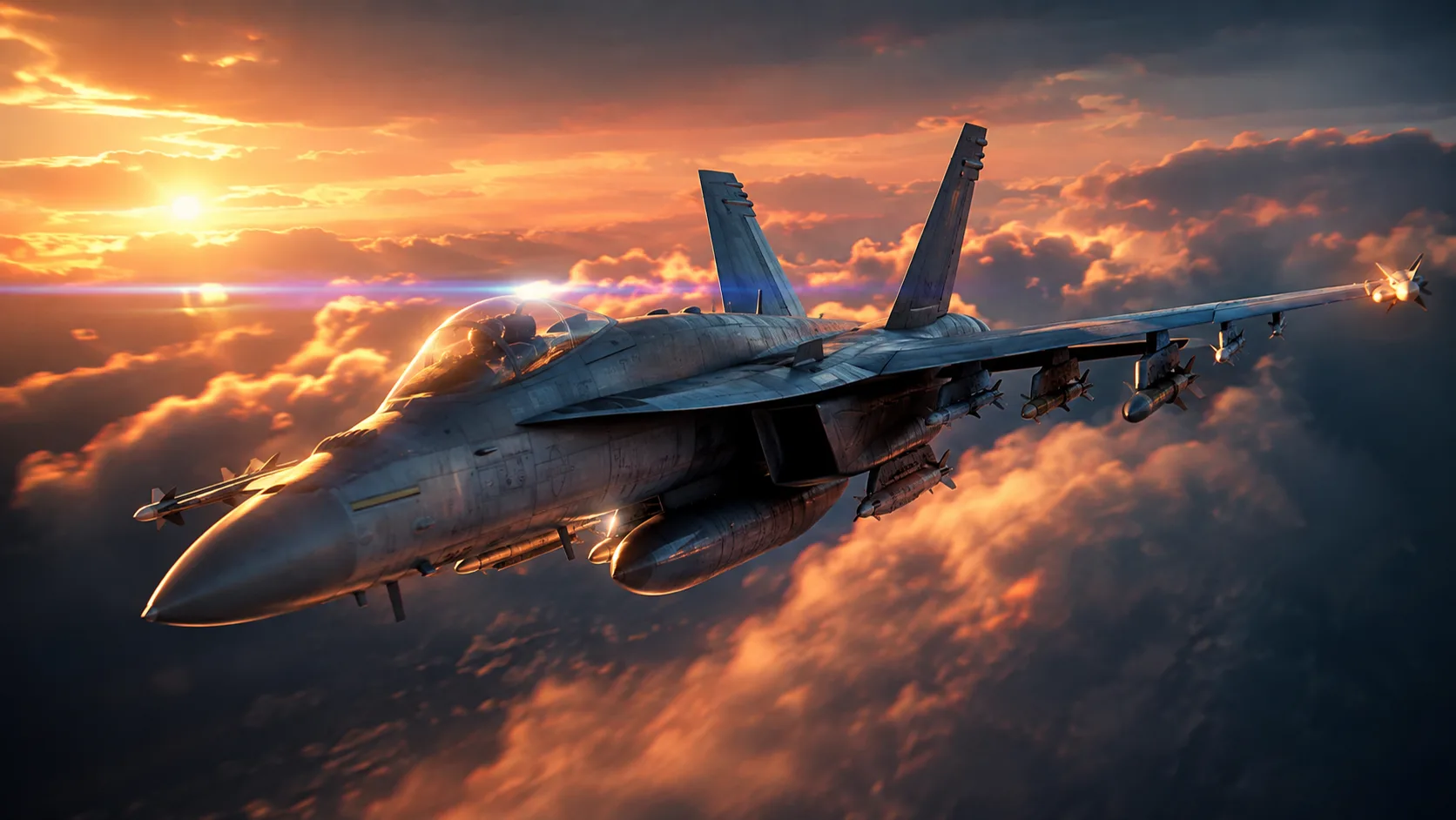
Seedance 2.5 — aircraft sequence prompt
CINEMATIC MULTI-SHOT SEQUENCE — 8 SECONDS — STRIKE PACKAGE

Format & Look: Shot on fine-grain cinema film emulation, 2.39:1 anamorphic widescreen, realistic anamorphic lens distortion with horizontal blue streak flares, oval bokeh, subtle barrel warp at frame edges, natural halation on sun highlights, organic film grain, high dynamic range. Photoreal live-action aerial cinematography in the visual language of Top Gun: Maverick — practical, weighty, no CGI sheen.

Time & Light: Golden hour at high altitude, sun low on the horizon, warm amber rim-light raking across the airframe, deep cobalt shadows, backlit cumulus deck glowing orange beneath.

SHOT 1 (0.0–2.6s) — Tracking Hero Profile: Camera flies in tight formation alongside the jet, matching its speed, slight parallax drift as the aircraft holds level flight. Sun flares kick across the canopy in a hard anamorphic streak. Heat shimmer ripples from the exhaust nozzles. Clouds rip past below at speed.

SHOT 2 (2.6–5.0s) — Low Rear Three-Quarter Chase: Hard cut. Camera drops behind and below the tail section. Afterburners ignite — twin blue-white cones with shockwave diamonds, exhaust distortion boiling the air. The jet snaps into an aggressive banking turn, wings rolling steep to the right, vapor cones tearing off the wing roots and leading edges, condensation streaming over the fuselage. Cloud tops blur past inches below.

SHOT 3 (5.0–8.0s) — Canopy-Adjacent Close & Pull-Out: Whip-pan cut to a tight shot near the cockpit — pilot's helmet visor reflecting the burning horizon, subtle head-check turn toward camera, gloved hand steady on the controls, airframe panels vibrating with micro-jitter. Camera then pulls back and up rapidly as the jet accelerates away, punching through a cloud pillar and shrinking toward the setting sun, contrails carving the sky.

Camera Movement: Aerial gimbal-mount realism — controlled handheld micro-shake, rolling shutter absent, natural inertia in every push, drift and re-frame. No teleporting camera moves.

Physics: Accurate airspeed motion blur, ordnance and pylons rigid under G-load, wingtip vortices, sun glint traveling across metallic panels, atmospheric haze depth layering.

AUDIO (no music): Precise environmental sound design only — thunderous turbofan roar with doppler shift on each cut, afterburner ignition boom and low-frequency rumble, high-altitude wind buffeting over the airframe, faint cockpit oxygen-mask breathing and clipped radio comms crackle, distant sonic pressure wave as the jet departs frame.

Negative: no music, no text, no on-screen graphics, no slow motion, no cartoonish smoke, no morphing geometry, no warped ordnance, no extra aircraft.
06 — THE CITY COVER SHOT The missing shot only became obvious in the edit
Once I started editing, the jump between the intimate room and the aircraft felt too abrupt. The film needed a breath and a sense of place. I found an aerial photograph of Lahijan, transformed it into a warmer cinematic still and animated it as a five-second aerial move.
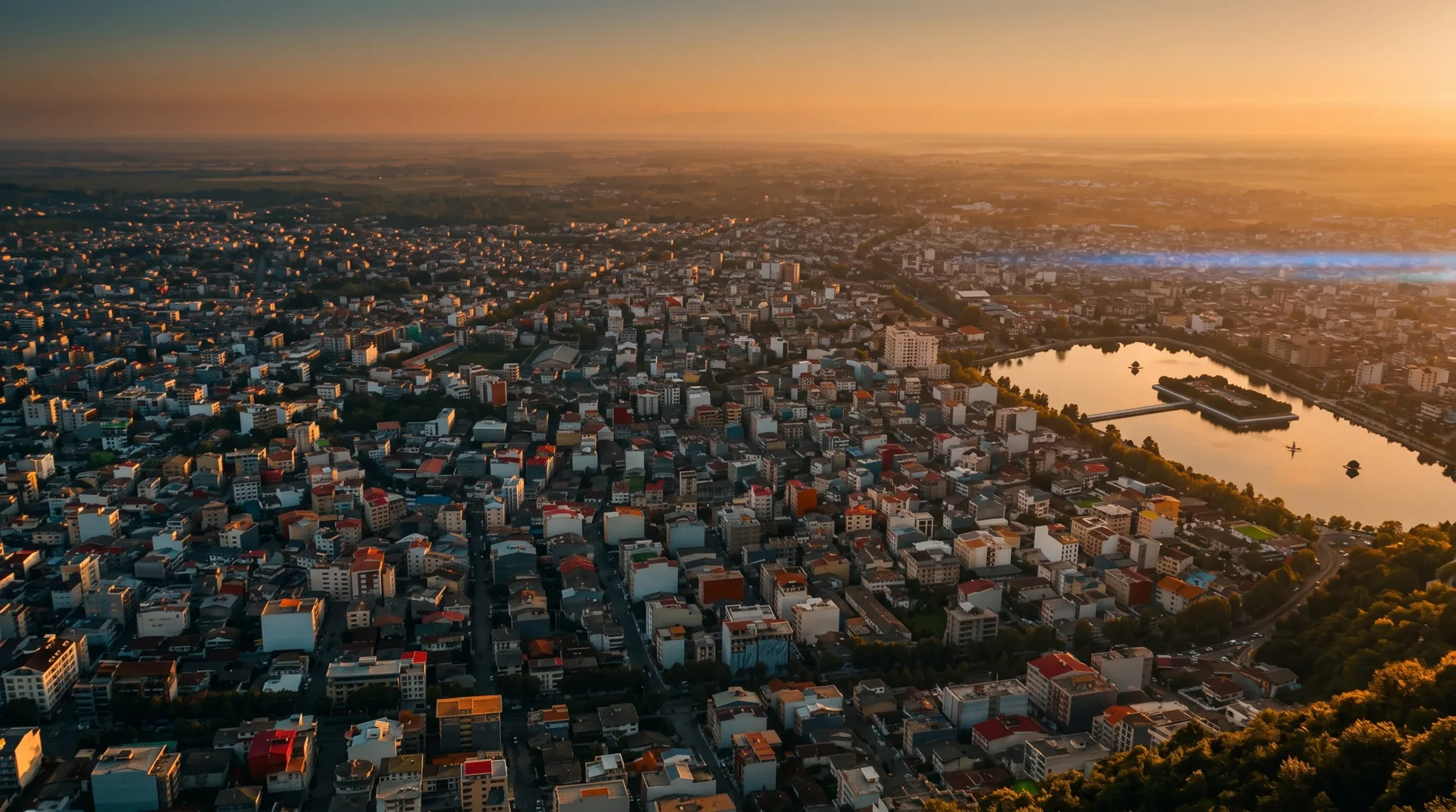
Lahijan cinematic still — image prompt
Transform the provided aerial photograph into a cinematic, feature-film-grade still.

Grade & Time of Day: Recompose the lighting for golden-hour sunset — low, raking sun casting long directional shadows across the rooftops and street grid. Warm tonal palette: amber, honey-gold and burnt-orange highlights, soft terracotta midtones, and cool teal-slate shadow separation for classic cinematic color contrast. Sky graded into a gradient of warm apricot near the horizon rising into deep dusk blue, with sun-flushed haze layering the distant plain for atmospheric depth.

Camera & Format: Fine-grain cinematic film emulation, large-format aerial plate, shot on an anamorphic prime — realistic anamorphic characteristics: subtle horizontal barrel distortion, oval bokeh, gentle edge falloff and corner smear, horizontal blue-streak flare kissing the sun side of the frame, mild vignette. Wide 2.39:1 cinematic framing sensibility with elevated aerial perspective preserved.

Texture & Detail: Organic 35mm film grain, natural halation around specular highlights and reflected sun glinting off the lake surface and window glass. Rich micro-detail in rooftops, foliage and water reflections without over-sharpening. Deep filmic contrast curve with lifted, slightly desaturated blacks.

Mood: Serene, epic, painterly — the city bathed in the last warm light of day, hillside forest in the foreground catching golden rim light, lake surface mirroring the sunset sky.

Photoreal, high dynamic range, no digital over-processing, no HDR clipping, no text or watermark alterations.Seedance 2.5 — Lahijan aerial prompt
Aerial Drone Shot — Lahijan, Gilan, Iran

Cinematic aerial drone footage over the city of Lahijan (location: 37°12'11.4"N 50°01'08.3"E), northern Iran (Gilan province), captured at golden-hour sunset. The drone flies in a smooth, continuous forward push — steady altitude, gliding over terracotta rooftops, dense green tea plantations terracing the surrounding hills, the lake and its historic Sheytan Kuh hillside, minarets and low urban sprawl blending into misty Alborz foothills on the horizon.

Camera & Optics: Professional cinema drone, fine-grain filmic capture. Anamorphic cinema lens with realistic anamorphic characteristics, oval bokeh, subtle horizontal barrel distortion at frame edges, gentle edge softness and natural lens breathing, delicate blue horizontal flares as the low sun clips the frame.

Lighting & Color: Warm color tonality — amber and honey-gold sunlight raking across the landscape, long soft shadows, hazy atmospheric depth with low-lying humid mist typical of the Caspian region. Warm highlights rolling into cool teal shadows, rich but natural saturation, filmic highlight roll-off, subtle organic film grain.

Motion: Slow forward dolly-in through the air, absolutely stable gimbal, no jitter, no whip pans. Cinematic pacing, single unbroken take.

Audio: No music. Realistic ambient sound design only — high-altitude wind, faint distant city hum, muted traffic and call-to-prayer echo far below, occasional birds. Natural spatial reverb, accurate falloff and air pressure.

Quality: Photorealistic, 8K detail, high dynamic range, professional aerial cinematography.
07 — POST-PRODUCTION The generated clips still had to become one film
The last stage was editing: choosing usable moments, controlling pace, building sound, matching colour and contrast, hiding weak transitions, and deciding exactly when each image should disappear. This part has its own craft, and a useful breakdown would make this article twice as long, so I will cover it separately.
The short version is simple: AI gave me raw material. Direction and editing decided what the audience finally felt.
08 — WHAT I TOOK FROM THE PROJECT Five practical lessons
- Collect information before writing prompts.
- Decide what the film is trying to do before designing shots.
- Use location and character sheets when continuity matters.
- Treat generated clips as raw footage, not finished films.
- Let the edit reveal which missing shots you actually need.
If you want the result without dealing with all these stages yourself, send me a short brief through this site. Tell me what you want to make, and I will find the strongest way to make it.
Reader comments
No comments yet. Start the conversation.